
Telling a Creator’s Official Social Media Accounts From Impersonators Using Website Links, Verification Badges, and Posting History
Finding the same username on YouTube, Instagram, TikTok, X, or another platform does not prove that every account belongs to the same creator. Usernames can be claimed by unrelated people, reused after changes, or deliberately copied by impersonators. Profile photographs, banners, biographies, and recent posts are also easy to reproduce.
A stronger verification process starts with sources that the creator already controls and then examines continuity over time. Official website links, platform verification, account age, posting history, original content, and payment destinations should support one another.
This becomes especially important when an account asks followers to purchase merchandise, pay for commissions, join a membership, download a file, or move a conversation into private messages. The standard of proof for casually following an account can be lower than the standard used before sending money.
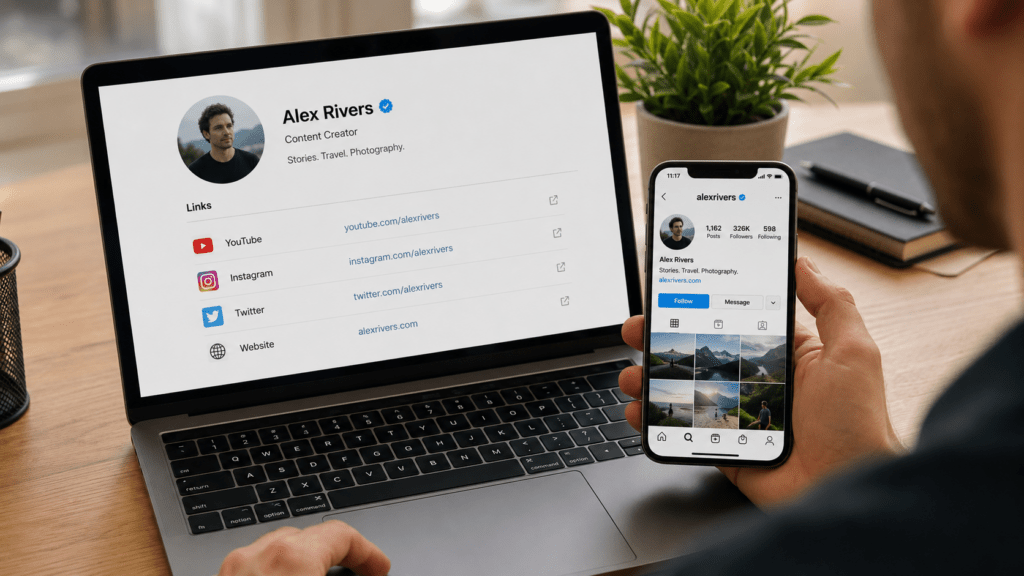
Official Link Networks and Bidirectional Confirmation
The strongest starting point is a creator-controlled source that is already independently known to be official.
This may be the creator’s own domain, an agency profile, an established primary channel, or a company page that identifies the creator. From there, follow the social links published by that source rather than searching for the same username manually.
YouTube allows creators to place multiple external profile links directly on their channel page, making links from an established channel useful evidence when tracing secondary accounts. A creator may use different handles on each platform, so the destination URL matters more than whether the usernames match exactly.
A useful verification chain might look like:
official website → YouTube → Instagram
Then test the route in reverse:
Instagram → official website or YouTube
Bidirectional linking is particularly useful because it shows that the identities form a connected network rather than simply sharing similar branding.
One-way evidence should be interpreted according to its origin. If a known official website links directly to a TikTok account, that is much stronger than an unknown TikTok profile claiming in its biography to be connected to the website. An impersonator can write someone else’s domain in a profile; it cannot normally make the creator’s genuine website link back to the impersonating account.
When only the candidate account claims the connection and no known official source mentions it, keep the account’s status unresolved.
Also inspect the complete URL rather than the visible link label. A profile may display the creator’s brand name while sending the user to a different domain.
A simple record can contain:
| Source | Links to | Reverse link found | Assessment |
|---|---|---|---|
| Official website | YouTube A | Yes | Strong connection |
| YouTube A | Instagram B | Yes | Strong connection |
| TikTok C | Official website | No official link back | Further verification needed |
| X D | Merchandise page | Merchant not listed elsewhere | Payment verification needed |
Verification Badges by Platform
Verification badges are useful, but their meaning is platform-specific.
YouTube states that a verification badge identifies a channel it has verified and that verified channels help distinguish the official channel of a creator, artist, company, or public figure from similarly named channels. YouTube also notes that changing a verified channel’s name removes its verification until it is verified again, while changing the handle alone does not remove the badge.
TikTok’s badge has a similarly strong identity meaning. TikTok says its verified badge indicates that it has confirmed that the account belongs to the person or brand represented. The actual badge appears next to the account name; a checkmark pasted into the biography is not TikTok verification.
Instagram currently states that a verified badge indicates that Instagram has confirmed the account as the authentic presence of the person or brand represented.
X requires a different interpretation. Its current blue checkmark is associated with an eligible X Premium account and is not, by itself, equivalent to the older system in which a blue badge primarily represented notable-account verification. X provides separate identity-verification information and uses other labels, including gold badges for official organizations through Premium Business.
For cross-platform checking, this means a badge authenticates only the account on the platform where it appears.
A verified Instagram account called @creatorname does not automatically prove that @creatorname on TikTok belongs to the same person. Return to official cross-links before transferring trust from one service to another.
Account Age, Name Changes, and Posting Continuity
Impersonation becomes harder to detect when a copied account has accumulated enough posts to look established. The timeline provides additional evidence.
Where the platform exposes account-age or historical information, inspect it.
Instagram’s “About this account” information can show when an account joined the service. For some accounts, Instagram also exposes information about former usernames, which can help users understand whether the account has recently changed identity.
That information is useful when a creator who has been publicly active for years appears to have an account created only recently.
A new account is not automatically fake. Creators regularly join new platforms, restart channels, or move after losing access to an older account. The important question is whether the move was announced through established channels.
For example, suppose an illustrator has posted on YouTube and Instagram since 2021. In August 2026, a TikTok account using the same name suddenly appears.
Look for continuity:
- Did the established Instagram account announce the new TikTok?
- Does the new account begin by referencing an ongoing project already documented elsewhere?
- Are the creator’s event appearances, release dates, or livestream schedule consistent across platforms?
- Did an agency or official website add the new link?
- Does the new account explain a handle change or previous-account loss?
Posting intervals also help.
An authentic creator’s accounts do not need identical schedules, but their public activities should normally make chronological sense. If the official YouTube channel announces attendance at an August convention and the candidate Instagram account simultaneously posts genuine behind-the-scenes images from that event, the histories support each other.
By contrast, a recently created account that copies years of old material in a few days but contains no connection to current projects requires more caution.
Do not judge from follower count. An impersonator can attract followers quickly, while a genuine newly opened account may initially have very few.
Original Content Sequence and Source Quality
Copied content is weak proof because impersonators can repost public photographs and videos within minutes.
When two accounts publish the same material, examine the sequence.
Record which account posted first, but do not treat first publication alone as decisive. A creator may schedule posts differently across services, provide material to staff, or post first in a members-only space.
More useful evidence can come from material that is difficult to obtain from a public repost.
Examples include:
- a higher-resolution original image
- uncropped artwork showing edges missing from public versions
- progress photographs or sketches from before completion
- raw footage followed by the finished video
- a project file shown during a livestream
- several stages of a commission or illustration
- an announcement posted before the final public release
Watermarks also need careful interpretation.
A copied account can leave the original watermark intact. A more deceptive impersonator may crop it away or add a new watermark on top. Neither action establishes authorship.
Suppose the established creator posts a finished illustration on Instagram at 7 p.m. An unknown X account posts the same image at 7:05 p.m. with the watermark removed. The X post is evidence that the account obtained the image, not evidence that it created it.
If the creator’s official YouTube channel had already shown the drawing process several days earlier, that production history carries much greater weight.
For photography, music, illustration, animation, or design accounts, continuity of creation can be especially valuable because it connects multiple pieces of content over time rather than relying on one easily copied final image.
Contact, Commission, and Sales-Link Consistency
Payment-related information deserves a stricter verification standard than ordinary posts.
A creator may legitimately change a merchandise store, commission form, business email, or payment processor. The change should still be confirmable through an established channel.
Compare the candidate account with the creator’s official website and older verified profiles.
Record:
business email → commission page → merchandise store → sponsorship contact → membership platform
The details do not need to remain unchanged forever. What matters is whether a change appears consistently across trusted sources.
A sudden private message saying:
“Use this new bank account from now on”
should not override the payment instructions on the creator’s official website without additional confirmation.
The same rule applies to unfamiliar storefront domains. If Instagram suddenly promotes a new merchandise site, check whether the creator’s website, YouTube profile, agency page, or other established account also announces the store.
Pay attention to the recipient identity during checkout. A creator may legitimately use a company or payment processor whose legal name differs from the public brand, but the relationship should be explainable.
Warning patterns include:
- a new payment address communicated only through DM
- requests for authentication codes or passwords
- a commission account name unrelated to previously disclosed business information
- a supposed limited-time offer absent from every established official channel
- pressure to use irreversible payment methods before verification
- a download link sent privately from an account whose ownership remains uncertain
If the contact information has changed, verify it through a second official route before sending money.
Official Community and Fan-Run Account Boundaries
Not every account connected to a creator needs to be personally operated by the creator.
An agency may maintain schedules. A staff member may operate a merchandise account. Fans may run an archive or translation community with the creator’s knowledge. These are different relationships and should be described accurately.
The same issue appears when a social account directs users to Discord, NAVER Cafe, a forum, or another fan space. How to Distinguish a Fan-Run Community From an Official Community Managed by the Creator provides a useful framework for separating creator-managed communities from independent fan spaces through administrator identities, official cross-links, ownership notices, and payment destinations.
A fan-run community can be accurate and valuable without becoming an official creator channel.
A secondary account should therefore be categorized rather than simply marked “real” or “fake”:
Creator-operated account
Directly controlled by the creator.
Agency or staff-managed official account
Officially authorized but operated by another person or company.
Official archive or clips account
Confirmed by the primary creator channel for a defined purpose.
Fan-run community or archive
Independent and clearly disclosed as unofficial.
Unverified account
Connection cannot yet be established.
Impersonation account
Presents itself as the creator without authorization in a way that may mislead users.
This classification is more useful when deciding whether a schedule can be trusted, whether a payment request is appropriate, or whether a private message actually came from the creator.
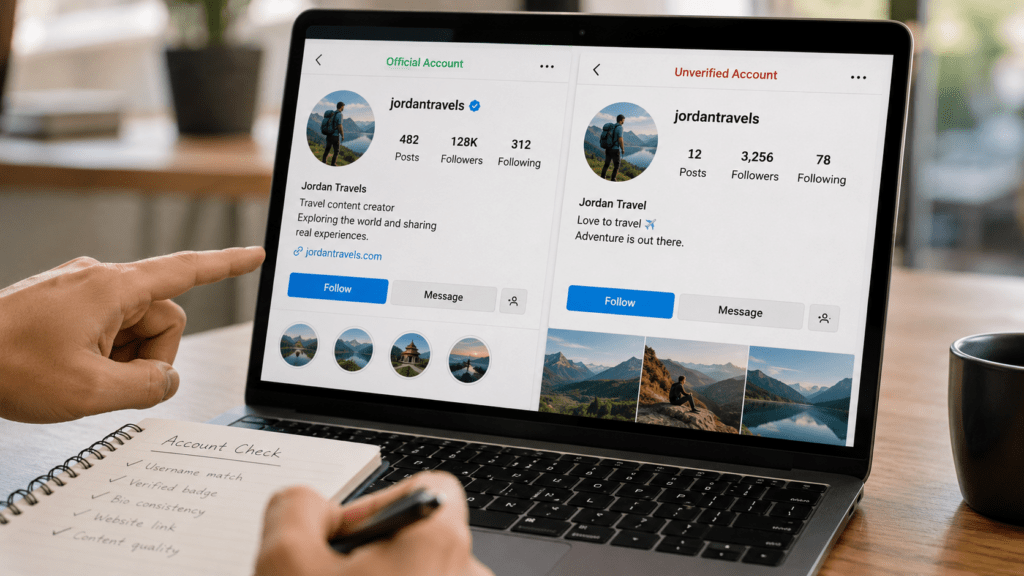
Evidence Records Before Payment or Sensitive Contact
When ownership remains uncertain, preserve the evidence instead of relying on memory.
A short verification record can include:
Profile URL: exact account address
Current handle: username visible today
Date checked: verification date
Account age: when available
Former usernames: when available
Verification badge: platform and badge type
Official website link: yes or no
Reverse link from official source: yes or no
Earliest matching content: date and source
Current project continuity: matching or inconsistent
Business contact: matches official site or not
Sales link: matches established channels or not
Status: official / staff-managed / fan-run / unverified
This approach strengthens trustworthiness because another person can follow the same evidence instead of being told simply that an account “looks official.”
It also reduces the risk of outdated verification. Creators can change agencies, domains, usernames, stores, and platforms. Record the date on which the relationship was confirmed.
When the decision involves money or sensitive information, require stronger evidence than a username, profile photograph, or follower count.
The most reliable sequence is:
known official source → reciprocal account links → platform badge meaning → account and name history → posting continuity → original-content sequence → contact and sales-link consistency
A copied username can imitate identity at a glance. A consistent history across independent official sources is much harder to imitate.